Showing posts with label Churches. Show all posts

Friday, April 21, 2023

Arthurvale Adventure

Coddiwomple: to travel in a purposeful manor towards a vague destination.

Sometimes I coddiwomple my way through life, sometimes I have a set destination but get there in a random way. There are no wrong ways to explore, but there are wrong turns. 

On this particular trip I was actually headed somewhere specific and never ended up getting there. I made some 'right' turns and ended up finding an old church and some other signs (literally) that indicated that a community once thrived here. I had found St. Hilda's Anglican Church in the district of Arthurvale.

Image from 'A History of the Huxley Area'

Many of the first permanent settlers to this area were English men and women who belonged to the Anglican Church. It was a long trip to the closest Anglican Church and the local community asked for their own services. The first service was held on July 29, 1905 in the home of a local man, with 38 people attending. Services continued to be held once a month in various homes until a church could be built. Lumber was purchased in June of 1907 and work progressed through the summer and even though the church was not complete, the first service was held October 27, 1907. Many of the churches furnishings were sent from England by friends and relatives. 

I found out that occasional services were held there right up until COVID happened and that there might be a Spring or early Summer service in the works. This church used to be unlocked for all to enjoy and sign the guest book, until recently when items were stolen from the church, forcing the caretakers to lock the doors. Makes you wonder what kind of person would steal also, it seems particularly evil to steal from a church. 


Just a hop, skip, and a jump down the road is a sign for the short lived Arthurvale Post Office. By the end of 1905 the community met and discussed having the Government establish a Post Office there and the Stephenson House was chosen as the location. The name Arthurvale was chosen after Arthur Stephenson, the only child in the district at the time. 

Post Office Sign and St. Hilda's in the Background.


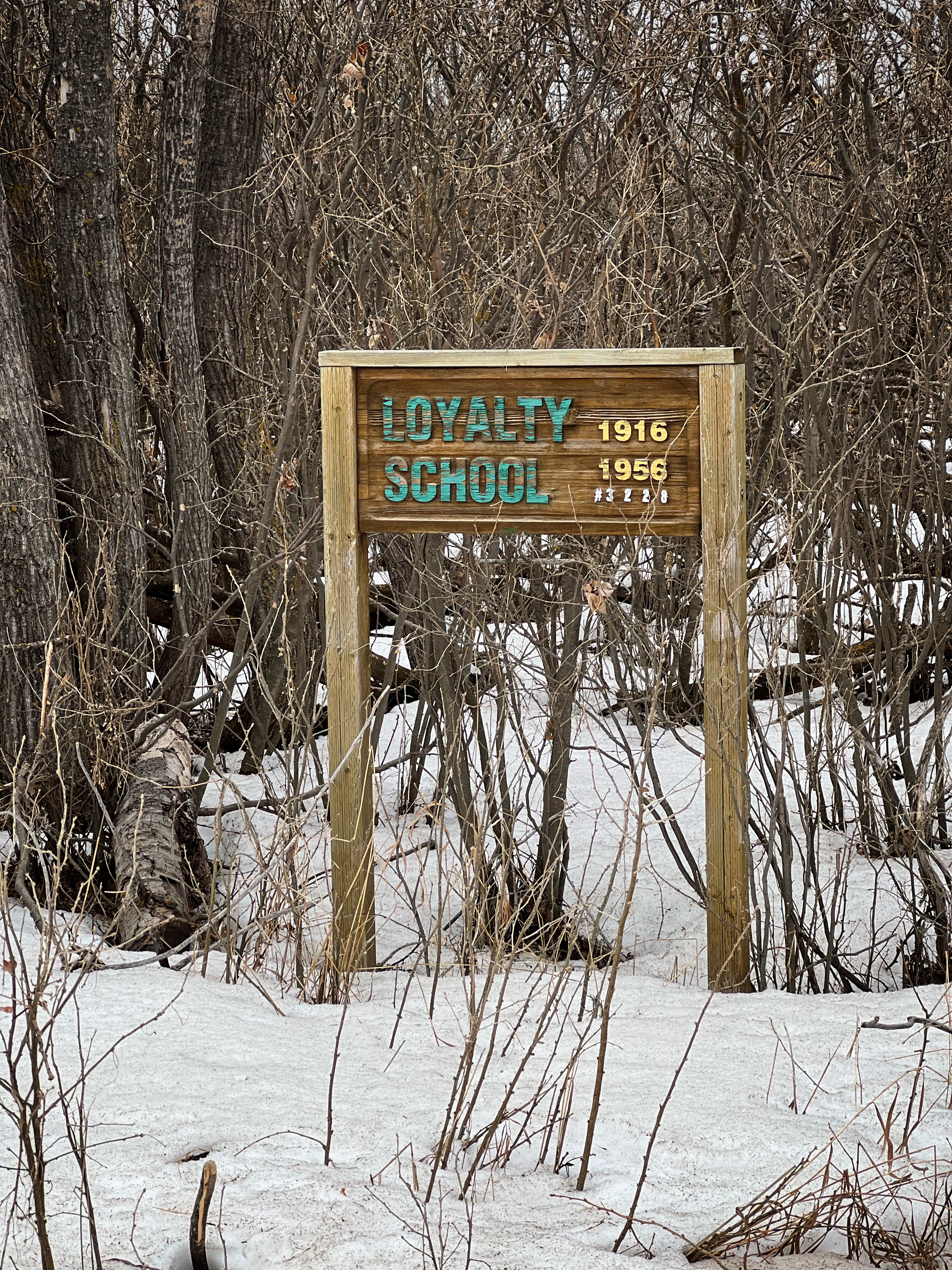
Another short distance away is the location of Loyalty School, the school is long gone but the entrance gate to the property is still there, just beyond the gate you can see a stone pillar that may at one time been part of a grander entrance or sign. The school opened in 1916 with 42 pupils. The school was already too small and another room was eventually added in 1925. By 1938, High School classes were being offered and the original Arthurville School was bought and moved (about 10km) on site and a dormitory built. The school closed in 1956 and the children were bussed to the nearby town of Huxley. 


What lies beyond..

The pioneers of the area now rest in Arthurvale Cemetery beside St. Hilda's but there are still those who care for the church and keep the history alive.

Sources: Pioneering with a Piece of Chalk and A History of the Huxley Area.


Tuesday, May 26, 2020

St. Peters Lutheran Church

Welcome to St. Peters Lutheran Church!

The history of this church starts in 1897 as German settlers from the Volyhnia region of what is now the Ukraine, emigrated to the 3 prairie provinces of Canada to start a new life. By July of 1897 a congregation was formed and the all German Sunday Services were conducted in the homes of the parishioners. In 1903 land became available and the church was built. During the tough times of the 30's members remained dedicated and the church was enlarged and a basement added. I would think this the same time the front of the church changed as well.  The first English Services happened in the 1940's, and electricity was added in the 50's.

As with many of pioneer settlements, farms change hands, the older generation passes on and more of the young people move to the surrounding towns and cities. An article I read from 2015 said there is still 2 services a month and the volunteers keep the inside and the grounds looking immaculate.

There is over 120 years of history here at this little country church and I am happy to have learned a bit of history today that I didn't know yesterday.

Photo by my kiddo, out of the car window, so I could remember the name, but it's also a cool sign!

c.1919

Wednesday, October 9, 2019

A Country Church

While out on the 'Great One Day Road Trip Expedition of September 2019', this was one of the churches along the way, near Innisfree. There is no shortage of churches in rural Alberta, some in use or occasional use, and some sadly on the verge of collapse. This one seems to be in the occasional use category. I couldn't find anything on this church in my usual search spots.

The badly faded sign states that this is a Seventh Day Adventist Church now. It likely wasn't always. However on the inside, along with Seventh Day Adventist bibles, there was a sign in Cyrillic (I think). Perhaps this church is used by a couple different congregations. I am not sure when someone was inside last but judging by some nice cobwebs all over my face, it might have been awhile. The grounds outside, however, were mowed and tidy.


Little cemetery in the corner.


I adore these light fixtures.
If you happen to know anything about this church, I'd love to hear it!

Sunday, September 29, 2019

Chailey Corner

I FINALLY got out for some exploring in an area I have been wanting to return to, this time with a map of stops. Very organized for me...very. I met up with a fellow blogger and friends, for a full day of nothing but back roads and beef jerky, my go to travel snack. Note to self: Back Roads and Beef Jerky as an alternate blog title.

I don't even know where to start with all the amazing places that I photographed. So I will start with Chailey. I don't think Chailey ever developed into a town but there was definitely a pioneer community. Now, the Chailey district consists of a school and a church surrounded by farmland. Both the church and the school are Municipal Historic Resources as well as being listed on the Alberta Register of Historic Places. 

There was also a post office there from 1907-1956, located in the homes of various local residents. In fact Chailey got it's name from the hometown of the first Postmaster, C.H. Brown, who came from Chailey in Sussex, England. 

Chailey School SD#2140 1910-1953
The school was completed in August of 1910 and ready to open it's door to grades 1-8. In 1922, it was expanded to it's current size. 2 years after the school closed it was acquired by the community for use as a hall. It is still used on occasion. 

St. Alban's Anglican Church 1908-1978
This area was settled by mainly British settlers and the received a 50 pound endowment from the Colonial and Continental Society of England. St. Alban's and other churches who also received this endowment are referred to as '50 Pounders'. This is something I'd like to learn more about later.

The church sits across the road from the school, surrounded by trees and a well kept lawn with a small cemetery in the back. The church itself is small and was built to seat only 36 people. It was not open unfortunately and I was not able to see the interior. I think it is still used for special occasions.

Enjoy the images of Chailey!


A new door and there is no teacherage now, otherwise it looks mostly the same!
I wonder if it was always blue? Top photo courtesy of the Provincial Archives of Alberta.

Play Ball?
A new sign for an old church.


So cute!


References: https://hermis.alberta.ca/

Tuesday, July 9, 2019

Clayburn Village

Not only was I 'West of the 5th' last week, I was West of the 6th and 7th too! Everything happened last minute and we headed off for a short trip out to Victoria, BC stopping at various points along the way and back.

I decided to look up ghost towns (BC has some great ones) but only 1 was near where we happened to be. Turned out to not be a ghost town at all but a little village with some history. Enough history that it was designated for conservation as a Heritage Site in 1996.  

Welcome to Clayburn, British Columbia, at the foot of the Sumas Mountains. Info from the village website states that Clayburn was the first 'company town' in BC.

They Clayburn Company made bricks from the high grade of clay found in the Sumas Mountains. The factory built in 1905, was dismantled/destroyed in 1931 with scaled back operations continuing at a sister factory, Kilgard, further up the mountain. Clayburn's last local brick making facility closed in 2011. 

During its heyday, not only did Clayburn make standard coloured bricks but they made buff coloured and specialty bricks. This made them sought after by architects and contractors for their originality. Clayburn bricks can be seen in many prominent buildings in Vancouver and Victoria built before WWI. During the 1920's the 'new wing' of the famous Empress Hotel in Victoria was built using Clayburn bricks. (The Empress deserves it's own post, it has fascinated me since I was a kid).

Not much remains of the original Clayburn brick works now (that I could see) except what looks like part of a wall, some ovens and pieces of brick embedded in the path way. The village itself has a quaint atmosphere with nice brick houses and lovely gardens. About half the original homes, a store, the church and the schoolhouse remain. The church and school are on the historic register of Canada. 

Enter here and follow the path

Brick ovens

Not a brick in this wall

Clayburn Church built in 1912

Clayburn Store...lots of candy and ice cream inside!

Clayburn School built in 1907
Clayburn School c.1925.

Stay tuned for more pics from our trip!


Friday, April 5, 2019

St. Michael's Catholic Church

It's hard to imagine that just 2 weeks prior to my visit, there was a crowd of about 200 on site to commemorate and acknowledge the history of the Hungarian settlers in the area. More on that here.

Here is a copy of the invitation that went out to local residents:


The reason I came to see the old church, also know as Manfred Hungarian Church, was that I heard that it is to be demolished. No date given but better to get out there sooner rather than later. When I arrived there was actually 2 other people there, in the cemetery. The man I spoke to confirmed that it was going to be torn down but he didn't know when. He said it's safe to go inside the church, so I took that as permission enough and made my way up the little hill to the church. The other visitors left and I was on my own, so if I had fallen through any floorboards, I might still be there.

The church, originally built in 1910, has gone through some changes. The church steeple was damaged in 1935 and was replaced by a wooden cross until 1955. The same year, a major reconstruction and renovation took place, which brought in a modern heating system and electricity.


Courtesy of the Ponoka News c.1910 at the consecration of the church when it opened.

As you will see in the photos below there is nothing left inside. The Ponoka News reports that the last wedding was performed in 1971 and 4 years later the church closed. The doors remained open until the mid 80's but were then locked due to the theft of some valuable items. I have to believe karma will get those who steal, especially from a church.

1955/56 after the renovation. Courtesy of the Ponoka News.


Now that we have seen the inside, minus the basement which I did not check out, let's see the outside!


You may notice it looks quite different than the original construction and quite unusual looking for a pioneer church. Shame that this unique building with an abundance of history will soon be no longer. I am hoping to head out there for some sunset photos as it is in a perfect location for some sunset action. I better not wait.

Thanks to Glen Bowe. Check out his blog post on this church:  https://glenbowe.home.blog/contact/


Friday, July 13, 2018

Meandering Through Mearns

One of things I like while out travelling is spotting a church spire in the distance. Like a moth to flame, I am drawn to that church!

From a distance is how we first saw St. Charles Borromeo Roman Catholic Church (Est. 1930) at Mearns, AB. Once we arrived at the church, we saw a house on either side of it and that appeared to be all there is left at Mearns. As we continued on our trip, we unintentionally found the St. Charles Cemetery just to the NE of the church. A sign at the location stated that the original St. Charles was located here from 1902-1930.

After looking up the church, it looks like it hold services once a month. Weekend masses rotate between it and 3 other parishes in the area. I have been to the 3 other places but only happened to take a photo of the church in Villeneuve. The other parishes are in Riviere Qui Barre and Calahoo.

Nice church. Darn powerlines.


At the entrance to the cemetery.

B&W and Darn Powerlines.