Showing posts with label Saskatchewan. Show all posts

Monday, November 9, 2020

Netherhill

West of the 5th went West of the 3rd this summer on a brief trip to the capital city of Saskatchewan. Yes, my summer vacation was in Regina. Not the summer one dreams of but with travel and gathering restrictions in place we couldn't just jet off somewhere exotic, not that we had planned to anyway but the point is we could have in any other year. We did get to meet up with some family and I was able to explore. Win/win under these circumstances. 

I had nodded off while on the road (something I can do within a block of leaving home, it's like my superpower when I am a passenger), and missed Netherhill on the way. I declared that we would be stopping there on the way home. 

I had seen pictures of this school many times and could not simply pass it by! View a great article and more pictures HERE by my friends over at BigDoer.com

I had been watching the weather and was hoping for some cloudy skies, because I love a cloudy dramatic sky and that it is how I pictured this school in my head. It was not meant to be.


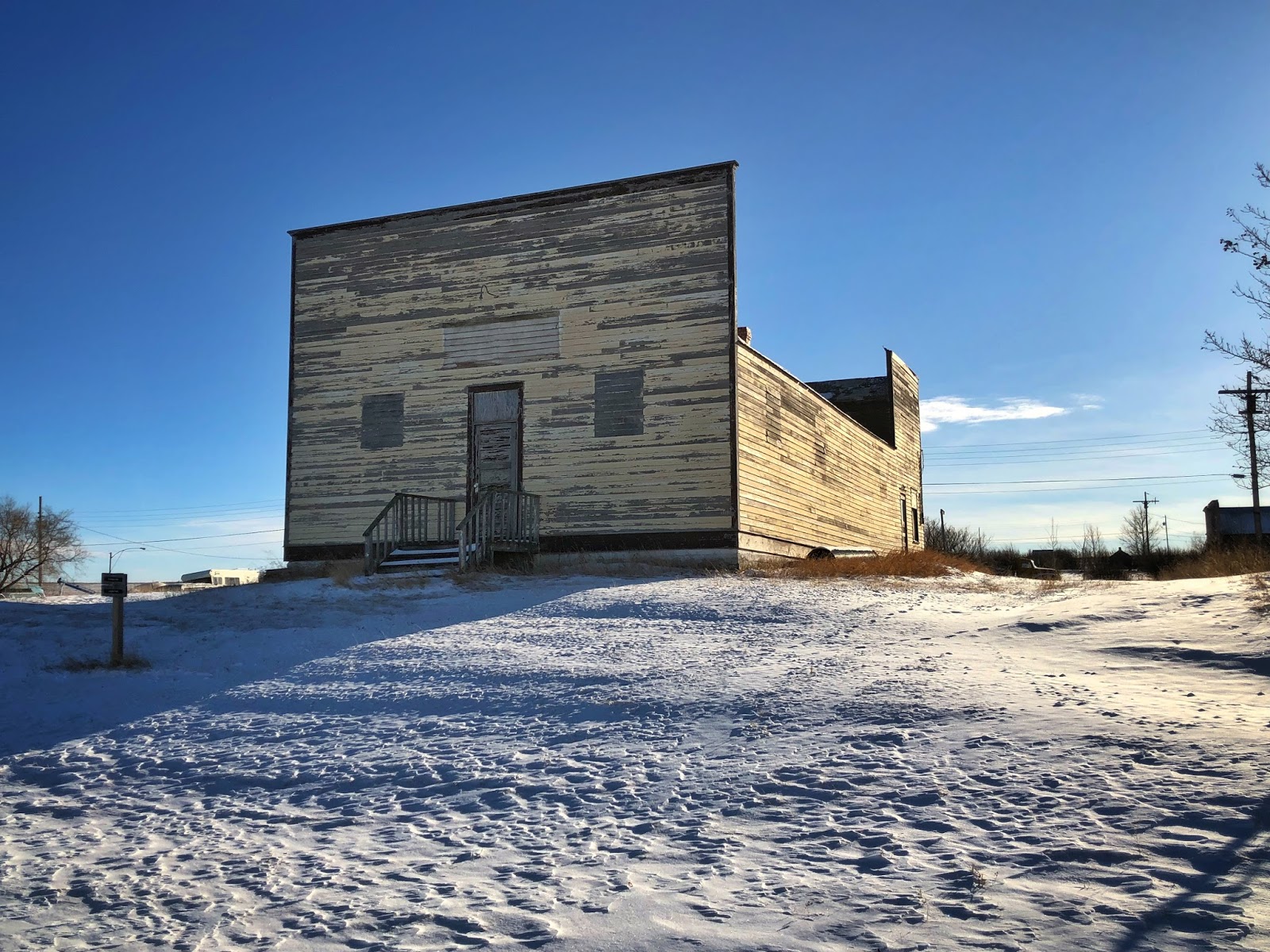
From the book, 'Memoirs of  Hillsburgh Rural Municipality No. 289', it states that Netherhill School was built in 1912, and received additions. Miss Railton was the first teacher and it was later consolidated with Eagle Lake School.  I have no dates of when it closed as a school, but above the door is the IOOF logo, so it became an Independent Order of Odd Fellows hall for a time before it was boarded up.

I found an image of the school prior to the additions at pararie-towns.com:

Looks incomplete after seeing how it looks now!

Once you pass the school, there is a town, population of 25 according to the 2016 census. It was pretty quiet and we did not see another person. We found the hotel next to the railway tracks though....which is almost a given in most of these prairie towns. 

It looks like it may be lived in? 

Wednesday, March 7, 2018

Lonely in Loverna

Another place that I have always wanted to visit is Loverna. It is just over the border into Saskatchewan and has only a couple of residents left from what I understand. Census info from 2001 says 5 people live here, leaving it pretty close to earning ghost town status.

As with almost all prairie towns, Loverna came into existence in 1913 with the arrival of the railroad. To say the town boomed would be an understatement, several hundred people called Loverna home and there were several streets of thriving businesses. Today only a few buildings remain. There have been 2 fires over the decades that have destroyed many of the buildings. Markers placed along the streets tell what used to be there. There was hotels, a Chinese Laundry, Confectionery, Jewelry Store, Print Shop, Garages, Cafe, various other stores, hardware, insurance, gas station, churches, a Legion Hall, curling rink and more. It had everything! 

Today I snapped only a few pictures but definitely need more time to explore the rest of town, there was still quite a bit to see, including the curling rink which still exists. I think Spring might be a good time to go....no snow (hopefully) and before the bugs. Those are pretty much the 2 seasons.


Canadian Legion Hall

United Church


Anglican Church


Loverna elevators, now residing in Alberta on private property.

Date unknown (could probably guess based on the truck)
Photo from prairie-towns.com

Wednesday, November 8, 2017

Shiloh Baptist Church


On a brief trip into Saskatchewan, east of Lloydminster, I found this unique church and cemetery. It is the historic Shiloh Baptist Church and you can feel the history here.

I'll start the story of the Shiloh people (Note: they were not referred to as this until many years later) after the American Civil War ended. Many thousands of former slaves migrated to the Oklahoma territory to live. They lived in relative freedom there, until 1907 when the new state of Oklahoma elected a segregationist government. This prompted many families to leave Oklahoma and follow the promise of free land for those willing to homestead in Canada's west. They came, hoping to live free from racism and segregation. 12 families settled here, north of Maidstone, SK in 1910. While other families continued on to form the community of Amber Valley, north of Edmonton, AB.

While the Shiloh settlers still faced some racism in Canada they were able to persevere through harsh conditions and near poverty, a familiar story of pioneer times. Also familiar is their spirit, hard work and determination. The original 12 Shiloh families built a community that grew to 50 families.

The church, built in 1912, is made of hand hewn square logs hauled from the North Saskatchewan river. The furnishings, benches and pulpit, are all hand made and can still be seen in the church today. The church looks mostly the same as it did when it was new. It's simple and beautiful and a testament to the community that was here.


As families moved away, the church which was the heart of the community for social and religious gatherings, was closed in the 1940's. The last burials occurred in 1945-46, but special permission was granted for burials in 1975 for George Mayes and again in 1987 for his wife Lucille Mayes, who were part of the 1910 settlers. The cemetery is now closed forever.

In 1971 white crosses where erected in place of the head and foot stones that were typically used to mark the graves. Many of the stones had been removed by people who did not know that they were markers in an effort to 'clean up'. A stone cairn, erected in 2002, lists the names of all 37 buried in the cemetery. The names had to be rediscovered after the original church ledgers were lost.


In 1991 the Shiloh Baptist Church and Cemetery was placed on Canada's Historic Places register.
This cemetery, the only African American cemetery in Saskatchewan, and the simple log church make this a unique and intriguing place.

In 2002 Leander Lane, who's great grandfather Julius Caesar Lane was instrumental in leading the group from Oklahoma, formed the Shiloh Baptist Church and Cemetery Restoration Society with 7 others. They have completed a historically accurate restoration on the church and, when possible, used materials and methods that match the period when church was built.

This place is a must visit for anyone interested in Canada's history. It is a piece of history that I didn't know about and am glad to have learned something new. Judging from the guest book, people from far and wide have stopped here to visit. In fact the person who signed the book the day before we did listed that they were from South Africa.  History is everywhere, you just need to travel down the right road.


Some historic photos and information:

Undated photo from cbc.ca

Mattie Mayes (photo from http://www.sachm.org/)
Mattie Mays was born in 1858 in Georgia. She and her husband Joseph raised 13 children. They worked hard to see their children and grandchildren raised in freedom. She was respected in the community and helped as a mid wife if the doctor wasn't able to attend in time. She passed away in 1953.

Joseph Mayes was born in 1856 in Georgia. Not only was he a pastor in Oklahoma, but he helped lead the group to Canada and became a farmer in his 50's. He preached every Sunday as pastor of the Shiloh Baptist Church.  He passed away in 1958 and is buried at Shiloh Cemetery.


There is an active Go Fund Me page to raise funds for the upkeep of the church and cemetery.
Thank you!


References: historicplaces.ca; cbc.ca; rmeldon.ca; Regina-Leader Post; sachm.org; 
Photos taken on September 16th, 2017.

Thursday, September 28, 2017

St. Paul's Anglican Church

As teased in my previous post....here it is, St. Paul's Anglican Church in all it's glory!! This church is located in the Forest Bank area of Saskatchewan, which is north of the Village of Waseca.

I was hoping to find more info on this lovely church but the places I normally look are coming up with very little information. What I did find was that the church was completed in 1910 by volunteer labour. However the first service, a Harvest Festival, was held on September 19, 1909. I am not sure if that is correct or a typo. Regular services are still held here today.


We always try the door just to see, this time the front door was unlocked but the door to the main part of the church was locked. The following photo was taken through the window. It is a well kept beautiful church. 


Photos taken on Sept 16th, 2017.


Monday, September 25, 2017

Marshall and Forest Bank: A Short Journey into Saskatchewan

Recently I was in Lloydminster, AB. I say Alberta since I was staying on the Alberta side but part of the city is also in Saskatchewan. This brings up so many questions about laws etc...but I digress....

Saskatchewan is a mostly undiscovered territory for me. I wish I had paid more attention when I was younger, since I visited southern Saskatchewan just about every year. Fast forward many years...I had the opportunity to explore a bit in the very west central portion of Sask. On my earlier visit this year, I checked out Waseca, Paynton, and Bresaylor. This time I stopped in Marshall, and a couple other sites on the backroads.

In Marshall, we saw a train approaching as we were stopped beside the grain elevator, I didn't have time to get in a better position for a cool train + elevator shot. This is my 'Train Geek' attempt.

Comin' in hot!

Moving fast!

Marshall Hotel now.

Marshall Hotel then. Photo courtesy of http://peel.library.ualberta.ca
After Marshall, it was onto a couple of planned stops. Just down the road from the church I was looking for, I found an old school that had become a community centre. It has an overgrown baseball diamond, and some rusty playground equipment. No one has played there in awhile, but that didn't stop my son from trying out the spinny, rusty, probably will need a tetanus shot thing. However, the area around the community centre was mowed.

The church and the community centre are both called Forest Bank. What does this mean kids? It means there was a pioneer community here. I could not find much info on the school, but I did confirm it was Forest Bank School #1659. While I was taking photos, my son told me the door was open, so we took a quick peek inside. As we went in, a familiar smell hit me. It's not a pleasant or unpleasant smell, just the smell of an unused place. Dust and time and forgotten things.

Once you go in you have to go up or down, the basement level was flooded, but a look from the bottom of the stairs showed some desks and other furniture. Not much to see upstairs, just left over paraphernalia from it's days as a community centre, chairs, kitchen equipment and various odds and ends. We left and made sure the door was secure. Remember, touch nothing and take only photos.


Fun?

Game over.


Thanks for the Memories and a crude primitive chalk drawing.

Finger lickin' good.

Down the road is St.Paul's Anglican Church at Forest Bank. This place is beautiful and there will be post later this week, here is a teaser:


Photos taken on September 16th, 2017.


Wednesday, June 21, 2017

The Leaning Church of Bresaylor, SK


Bresaylor, Saskatchewan. What can I say about this place that will accurately portray my short time there? I am not a writer, in fact I have always disliked writing. I like to think of myself as a recreational photographer who has to say something about the photos I take. I am fully aware that my writing could be better and I look up synonyms a lot to avoid using the same words over and over. I really hope the pictures tell the story when I cannot.

Photo Courtesy of Sask History Online

A friend suggested I stop and see a church in Bresaylor.  I noticed that it was not far from Paynton, so I added it to my stops. I thought Bresaylor was a town but it's what's left of a hamlet and is now a heritage museum. If you look at the historic photo above, you can see it was a small village with 2 grain elevators across the road and the church in the top right, where it still sits. There is still a grain elevator across the highway, it's privately owned and repainted to read 'Blais Farms'. I read it is the old Federal Elevator as pictured above. It also appears to have been moved a bit west and turned a quarter turn judging by the buildings I recognize in the photo and where I was standing when I took the photo.

There was not a person in sight in Bresaylor but a sign that pointed to a house that said Museum Office and Gift Shop. The door was not open so I looked it up online and called a number that came up...I didn't come all this way to not see the church and I didn't want to go traipsing through someones property. A did get someone on the phone and asked if I could just take photos of the church and be on my way. She offered to come let us into the museum but warned they hadn't been cleaned or made ready for visitors. I didn't want to bother her and make her come from wherever she was but she insisted it was no trouble and to give her 10 minutes. While waiting for her we walked to the church, through a maze of fences and openings, and took some photos. I was instantly infatuated with this old, tilted, quirky looking church.


I assumed the lady I spoke to lived close but she came out of one of the houses in 'town'. I mistakenly thought that no one lived there. Oops. I had just met Velma, the museum curator, resident, groundskeeper and owner of the church. Velma was originally from the area but it was when she had returned to visit relatives that she found out the church was not being used, this drew her back to the area. She bought the church and actually lived in for a time. The church, Ste. Anne's Anglican, was built in 1906, coinciding with the arrival of the railroad, although services had been held in various homes and schools since 1882. The last service was held in 1966 for Joseph Sayers Sr. Velma has had the church foundation repaired but as you can see it has a lean to it due to being it being partially lifted and plopped back down during a tornado! The cost is too much to restore it completely.

The name Bresaylor is a mix of the 3 founding family names, the Bremners, the Sayers, and the Taylors. These Métis families had come here from Manitoba together in 1882. The museum contains artifacts from these early settlers as well as from the Barr Colonists who settled the area a bit later, around 1903. There is a ton of interesting history here!

Office and Gift Shop, former Bresaylor elevator across the highway


The Main museum house is known as the Alex Lennie house and was added to the Register of Canada's Historic Places in 2009. It was built in 1907. You can see this house (and possibly the office) in the historic photo, it is also still in it's original place. More on this house can be found here. Velma let us in through the back of the house. Inside the back entry the floor felt a bit soft under the old linoleum, I am guessing people normally enter through the front door. The museum as well as the office in the other house, were full of photos, old tools, kitchen implements, gadgets, the old post office window, and old Apple Mac computer (like I had in the late 80's at school), cobwebs, memories and history. These kinds of places are the types of places you need to see more than once because chances are you've missed something. I can't believe I didn't take photos inside! I guess I was busy listening to Velma. You can tell how much she cares about this place and it made me wonder what will become of it in the future?


The marker reads: This Plaque was Dedicated in the Jubilee Year 1955 to Honour the Pioneers who
Founded the Bresaylor Settlement in the N.W.T ? to 1905. Year unreadable but 1882 would make sense.

School Marker for Federal School #4048 1918-?
I gave Velma my address (mail not email) so I can receive the Bresaylor newsletter. I'd like to visit again and keep up with the activities. Thanks for reading!

Tuesday, June 13, 2017

Finding Salvation in Paynton, SK

Aerial view of Paynton, courtesy of Sask History Online
Sometimes you forget about a place. I had forgot about Paynton.

I had a family friend years ago who was from Paynton, SK. I had not heard his name or the name of the town in years. It certainly didn't occur to me that I would be close to there on my recent trip to Lloydminster. However, when I was looking at my map, I saw it on my route and knew I'd have to stop there. After my stop in Waseca, we passed Maidstone and then arrived in Paynton. Much like Waseca it has a population of around 150 people. Unlike Waseca, it no longer has any grain elevators.

Some history for you! Paynton was settled in 1888 by 3 retired constables of  the North West Mounted Police. In 1903 Rev. Isaac Barr, who had secured a large area of land, brought 2000 colonists from England to settle the area. They are known as the Barr Colonists. Along the journey to the new colony, bickering lead to many of the colonists leaving to form their own communities. Some settled in Paynton and more settlers soon followed. It was incorporated in 1907.

Silver Maple.
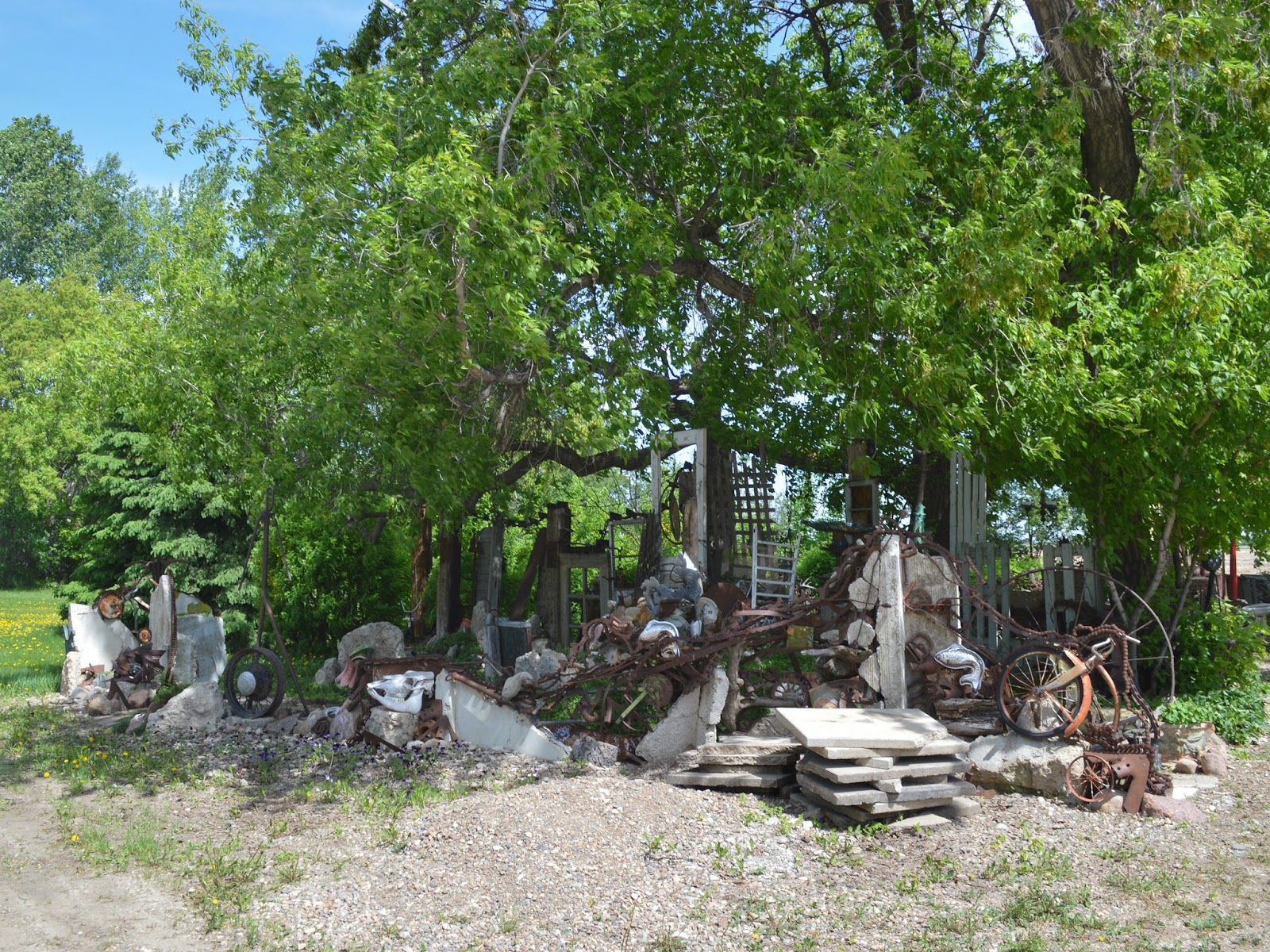
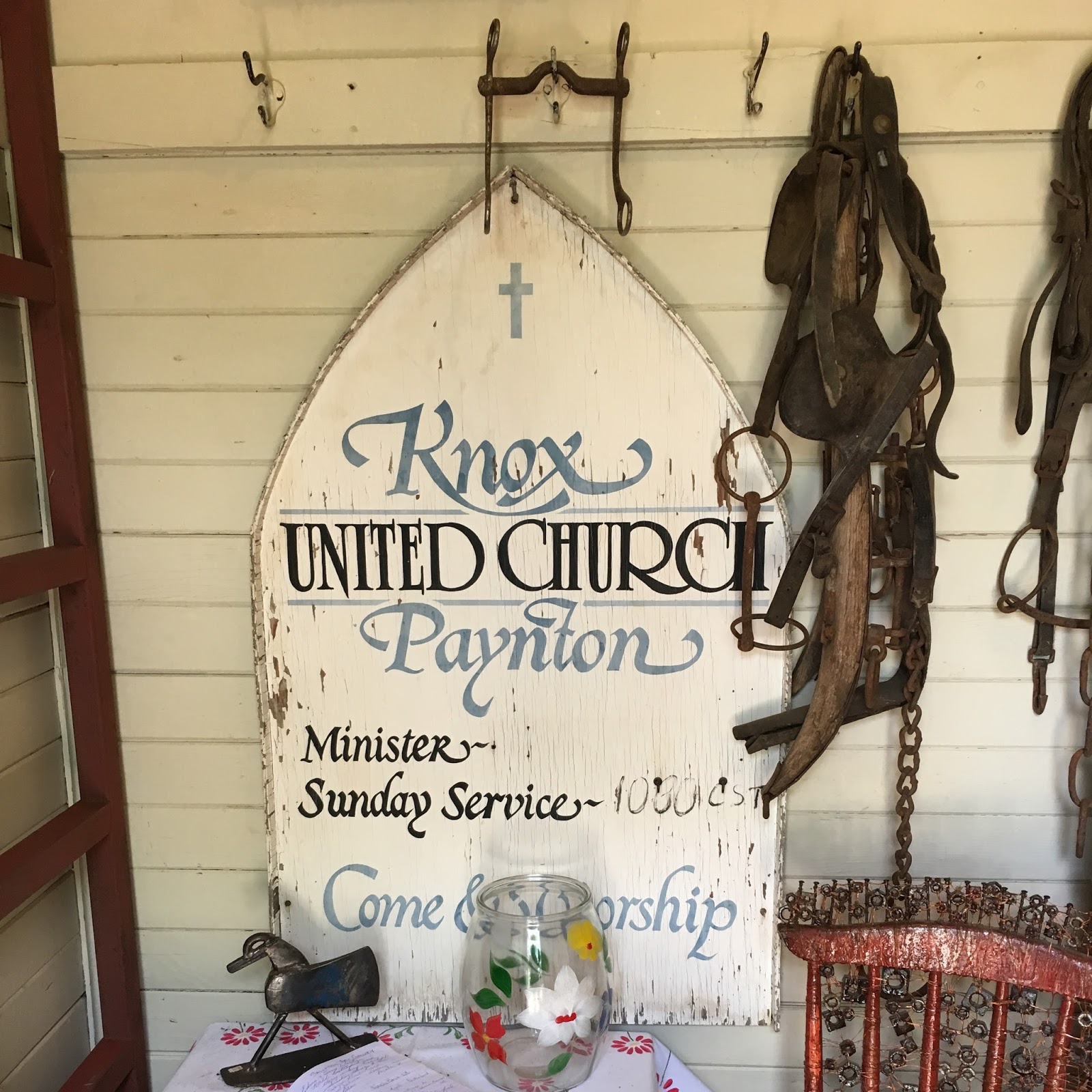
I drove the quiet, unpaved streets and took photos of a couple of churches that have been converted into homes. I wasn't able to get in contact with my friend so I did another loop and was about to leave when I noticed someone outside one of the churches. The first person I had seen in town! This church was surrounded by a mix of outdoor decor and what I would call folk art. I stopped to ask the lady about it and she asked if I'd like to see inside the church. Uhhhh, ya I would! Her name is Mariann and she has turned the church into the Salvation Art Gallery. It features some of her art, art work by locals, and some antiques. Most of the pieces are made from recycled materials. I picked out a small metal deer figure and a tea cup and saucer set in my pattern that she happened to have. (Yes, I have a china pattern, see photo.)

Deer?
The church needs some work, and renovations are ongoing (to be expected in a century old building and not cheap I'm sure). The interior though!! (insert wow face). The rich mahogany coloured wood seemed to shine and the vintage pendant lights were gorgeous. From what I read this was originally a Presbyterian Church built in 1909 and turned over to the United Church in 1925. Perhaps they added the lights, if I have my style era right.

I imagine living in a historic building, church or house has it's pros and cons. I could picture myself doing something like that someday and admire the commitment it must take to keep a place like that going.


I enjoyed looking at everything in the church and chatting with Mariann, and because it is a small town, she knew my friend and directed me to of the houses he might be at. Turned out he wasn't in town after all that. Figures.

I heard later that there are 3 former churches that are all homes now. I didn't see the 3rd one. If you look at the old photo at the top you can see the United Church in the bottom right. I think I see the 2 other churches as well but I can't be 100% sure.

Former Catholic Church, now private residence. 
A new history book of Paynton has been written and is being released this fall. I think I will look into getting a copy. Happy travels! Next Saskatchewan stop is Bresaylor!